

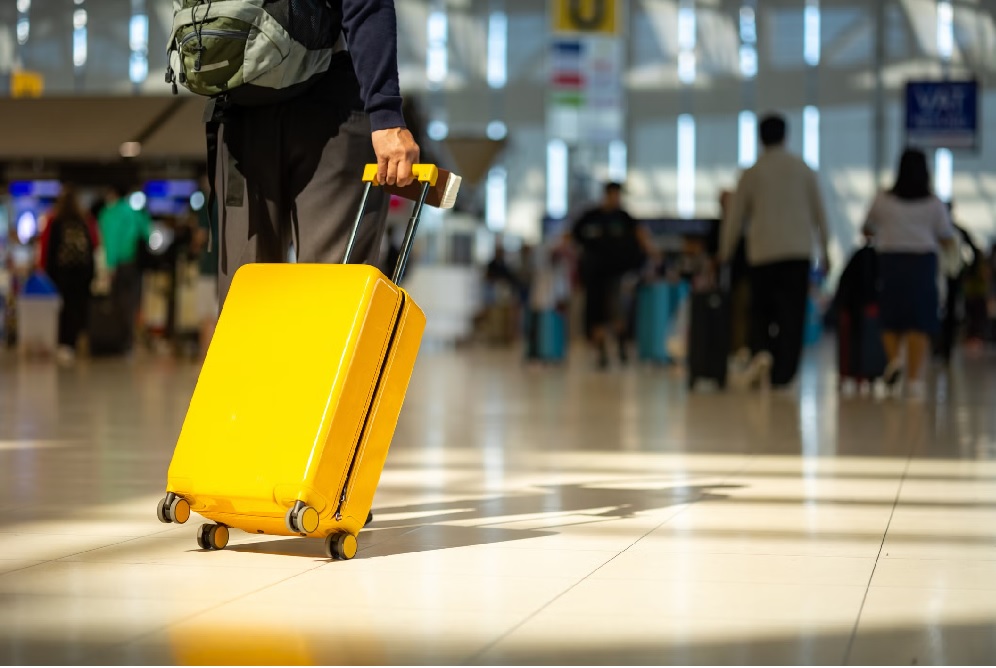
Every major luggage manufacturer loves to slap an alluring silver tag onto their suitcases: “Carry-On Approved.” It sits prominently on retail display racks across the United States, promising hassle-free passage through airport terminals from Seattle to Miami. You buy the sleek roller bag, pack your wardrobe for a ten-day vacation, and glide through domestic security lines feeling like a seasoned professional.
Then you book an international connection, step onto foreign soil, or switch to a regional partner airline, and your frictionless travel strategy falls apart.
An assertive gate agent steps out from behind the counter, points directly at your luggage, and gestures toward a battered metal sizer cage sitting near the boarding door. You try to slide the bag into the frame, but the wheels jam against the steel tubing. The front pocket bulges by an inch. Within sixty seconds, the agent pulls out a card payment terminal, assesses a seventy-five-dollar penalty fee, and tags your carefully packed suitcase for the cargo hold.
The reality of modern commercial aviation is that there is no universal definition of a carry-on bag. American travelers are routinely lulled into a false sense of security by lenient domestic airline practices, only to face aggressive enforcement, punitive fees, and arbitrary gate inspections when venturing abroad or boarding regional flights.
Navigating the skies with cabin luggage requires looking past retail marketing claims and confronting the strict, unyielding dimensions that airlines rarely advertise until you are standing in line to board.
The Domestic Illusion and the 22-Inch Myth
For decades, the unofficial baseline for domestic flying within the United States has been twenty-two inches tall, fourteen inches wide, and nine inches deep. Major legacy carriers like American, Delta, and United built their mainline aircraft overhead bins to accommodate bags fitting these approximate parameters. Because these domestic giants rarely police sizing unless an aircraft is entirely full, American travelers have grown accustomed to treating these measurements as loose suggestions.
International aviation operates under an entirely different dimensional philosophy.
Across Europe, Asia, Latin America, and Oceania, the prevailing international standard for overhead luggage is not twenty-two inches, but fifty-five centimeters in height, forty centimeters in width, and twenty centimeters in depth. Converted to the imperial system, twenty centimeters equals just 7.87 inches.
That single inch of depth difference is where thousands of travelers get ambushed every single day. A standard American roller bag measuring nine inches deep is already more than an inch too thick for international standards before you even place a single pair of socks inside it. If you use the expandable zipper gusset found on most commercial luggage, your bag expands to ten or eleven inches, guaranteeing an immediate violation at foreign check-in counters.
The Wheels and Handles Trap
The primary reason commercial luggage fails airport sizing checks is a fundamental disconnect in how bags are measured. Luggage manufacturers measure the usable packing capacity of the interior cavity. Airlines, by contrast, measure the absolute external footprint of the physical object.
A bag marketed as a twenty-inch suitcase often measures twenty inches only from the bottom of the fabric seam to the top of the fabric seam. Add two inches of protruding 360-degree spinner wheels at the base and a molded plastic carry handle at the top, and that twenty-inch bag suddenly measures twenty-two and a half inches tall.
Airlines do not care that the interior volume is compact. If the rigid casters or top grab handle catch on the lip of a metal sizing frame, the entire bag is classified as oversized. Spinner wheels, while delightfully smooth on airport concourses, are the primary culprit behind failed gate checks because they remain rigidly exposed outside the bag’s frame, unlike recessed two-wheel inline skate designs that sit flush with the base.
The Hidden Gauntlet of Gate Weight Limits
While dimensional restrictions represent a visible obstacle, the most insidious carry-on trap is one that domestic American flyers almost never anticipate: the cabin baggage scale.
Within the United States, carry-on weight is essentially an afterthought. As long as a passenger can lift their bag into the overhead locker without crew assistance, domestic carriers rarely care whether the suitcase weighs fifteen pounds or forty pounds.
Fly abroad, however, and weight enforcement becomes ruthless. Major legacy carriers across Europe, Asia, and Australasia enforce strict cabin weight ceilings:
-
European carriers frequently restrict overhead bags to eight kilograms (roughly 17.6 pounds).
-
Carriers across Australia, New Zealand, and Southeast Asia routinely cap carry-on weight at a rigid seven kilograms (just 15.4 pounds).
-
Select Middle Eastern carriers limit economy cabin bags to a single piece weighing no more than seven kilograms total.
To understand how brutal a seven-kilogram limit is in practice, you must calculate the tare weight of your luggage. A high-end, hardshell polycarbonate carry-on suitcase typically weighs between seven and nine pounds completely empty.
If your bag weighs eight pounds empty and the operating carrier enforces a fifteen-pound ceiling, more than half of your total weight allowance is consumed by the suitcase itself. That leaves you with roughly seven pounds of actual clothes, toiletries, and gear. Packing a single heavy laptop, a charging brick, and a pair of running shoes will push you past the legal threshold before you have packed a single change of clothes.
At international departure gates, ground personnel frequently stand beside portable hanging scales or platform scales, weighing carry-on bags at random during the boarding queue. If the scale displays 7.2 kilograms, there is no negotiation. The bag is redirected to the hold, and you are charged last-minute baggage rates.
Revenue Enforcement and the Gate Bounty
Gate-side enforcement has transformed dramatically over the last decade. Historically, checking bag sizes was a matter of basic cabin safety and ensuring overhead bins closed properly before taxiing. Today, it has morphed into a sophisticated revenue generation tool.
Budget carriers in Europe, Asia, and the Americas operate on razor-thin ticket margins. They rely heavily on ancillary fees to generate operational profits. To ensure maximum fee collection, many low-cost carriers contract their gate operations to third-party ground-handling agencies that operate under strict corporate performance metrics.
In some well-documented instances across secondary European and American airports, handling agencies have established incentive structures or individual commissions for staff members based on the number of non-compliant bags they intercept and monetize at the gate.
When a gate agent is financially incentivized or operationally audited on bag interceptions, there is zero tolerance for discretion. The metal sizer box ceases to be a guideline; it becomes a rigid financial trap. If your bag cannot drop smoothly into the box under its own weight—without pushing, shoving, kicking, or sitting on it—the credit card reader comes out immediately.
The Vanishing Personal Item Frontier
Faced with steep charges for overhead carry-on bags, many travelers pivot to the “personal item only” strategy, intending to travel with a single backpack that fits beneath the seat in front of them. Yet even this refuge is shrinking rapidly.
Ultra-low-cost carriers have systematically reduced the permitted dimensions of under-seat personal items. While standard legacy carriers allow reasonably generous daypacks, budget airlines have established millimeter-precise limits, often capping personal items at dimensions around sixteen by twelve by eight inches.
Furthermore, relying on the under-seat space assumes that the space under the seat in front of you is entirely clear. On many modern narrowbody airliners, that space is severely compromised:
-
Aisle seats frequently feature structural metal braces that cut under-seat width by a third.
-
Many modern aircraft house bulky In-Flight Entertainment (IFE) electronic control boxes beneath specific rows, occupying valuable foot space.
-
Emergency equipment, such as life raft containers or crew gear, is often mounted under passenger seats, leaving room for little more than a paperback book and a pair of sandals.
If your backpack is packed to capacity and bulges outward, it will stick out into your legroom area. Flight attendants conducting pre-takeoff safety checks are mandated by aviation regulators to ensure an unobstructed evacuation path. If your bag protrudes beyond the vertical plane of the seat cushion, you will be ordered to place it in the overhead bin—and if you did not pay for overhead access on a basic economy fare, you will be billed on the spot.
Regional Aircraft and the Forced Gate-Check
Even if your luggage complies with international dimensions and weight caps, the specific airframe operating your route can still derail your carry-on plans.
Positioning flights and feeder routes are overwhelmingly operated by regional jets and turboprops, such as the Embraer 170/190 series or the Bombardier CRJ family. The overhead storage lockers on these smaller airliners are fundamentally incapable of fitting a standard rollaboard suitcase wheels-first, and on older models, the bins on the left side of the aircraft are too shallow to hold anything larger than a winter coat.
When boarding a regional flight, passengers are subjected to the forced valet gate-check. While this service is typically provided free of charge, it presents significant travel risks that many passengers fail to prepare for:
-
Tarmac weather exposure: Valet-checked bags are loaded manually by baggage handlers on the open ramp. During torrential downpours or heavy snowstorms, soft-sided canvas bags left on tarmac carts can become soaked before reaching the belly of the plane.
-
Lithium battery confiscation: Aviation safety laws strictly prohibit loose lithium-ion power banks and spare electronics batteries in the cargo hold due to thermal runaway fire hazards. If you are forced to surrender your bag on the jet bridge, you must frantically unpack all electronic batteries, cables, and charging banks while other passengers push past you.
-
Vulnerability of critical supplies: Essential prescription medications, identity documents, and high-value fragile electronics should never enter the hold of an aircraft. If your primary carry-on is confiscated at the boarding door and you have not organized these items for instant extraction, you risk losing access to critical medical necessities should the flight divert or experience luggage mishandling.
Tactical Strategies for Bulletproof Carry-On Travel
Beating strict airline size and weight limits requires shifting from defensive packing to offensive preparation. You cannot rely on luck; you must engineer your luggage setup to withstand the most aggressive gate audit.
Ditch the Hard Roller for Structured Backpacks
The single most effective shift a traveler can make is replacing a hardshell four-wheel spinner with a soft-sided, frameless travel backpack.
Hard-sided suitcases have fixed exterior dimensions. If a hard suitcase is a quarter of an inch too wide for an airport sizer, no amount of force will make it fit. A soft-sided technical backpack with exterior compression straps can be cinched down tightly, eliminating empty space and compressing clothing into a rigid, compact profile that slides into sizer boxes with ease.
Furthermore, gate agents visually target wheeled suitcases. When boarding lines form, agents scan the crowd looking at handles and wheels rolling across the carpet. A traveler wearing a neutral, low-profile backpack over both shoulders looks significantly lighter and less cumbersome, routinely bypassing visual scrutiny while travelers with small roller bags are funneled toward the sizers.
Conduct the Baseline Home Audit
Never rely on the dimensions printed on a manufacturer website or hangtag. Take an ordinary tailor’s measuring tape and measure your packed bag at home before heading to the airport.
Measure from the very bottom of the wheels to the absolute highest point of the top handle. Measure the depth across the thickest part of the packed belly, not the corners. Finally, place the packed bag on a standard home bathroom scale. If your bag weighs more than fourteen pounds fully loaded, you are in immediate danger of failing international checks and must begin editing your wardrobe.
Master the Wearable Cargo Technique
When confronting an airline known for aggressive gate weighing, your clothing is your greatest strategic asset. Airlines weigh luggage; they do not weigh passengers.
Wear your heaviest, bulkiest items through the boarding gate:
-
Wear your heaviest footwear, such as leather boots or trail runners, leaving lightweight sandals or sneakers packed inside the bag.
-
Put on your heaviest jacket or technical sweater during boarding, even if the ambient cabin temperature is warm. You can take it off the moment you reach your seat.
-
Utilize outwear with deep interior pockets to hold heavy dense items during the gate check. A smartphone, an external power bank, a heavy camera lens, and an e-reader can be placed into jacket pockets, instantly stripping four to six pounds of dense weight out of your carry-on luggage. Once you clear the boarding scanner, those items can be transferred back into your bag.
Pay Upfront When Flying Ultra-Low-Cost
If you know you are flying a carrier with aggressive size restrictions and you must carry substantial equipment, never gamble on slipping past gate agents uninspected.
Airlines price baggage on an escalating fee tier. Adding a paid carry-on or checked bag during the initial online reservation typically costs a fraction of the walk-up fee charged at the departure gate. If your bag exceeds the strict regional limits and you cannot compress it further, purchasing the allowance twenty-four hours in advance preserves your travel budget and eliminates the humiliating stress of a public gate altercation.
The golden age of casual, unmonitored carry-on luggage has ended. Modern aviation is an ecosystem governed by tight physical margins, automated revenue tracking, and rigorous enforcement protocols. By measuring accurately, trimming unnecessary base weight, and choosing gear engineered for flexibility rather than showroom aesthetics, you can navigate international gates with complete confidence, keeping your belongings firmly within reach throughout your journey.
